About this archive
This is the digital catalogue of the work of the painter Rauscher György (in Western order Gyorgy Rauscher; in German-language sources Georg Rauscher; born Dorog, 29 April 1902; died Komárom, 3 October 1930), a painter of the new objectivity (új tárgyiasság / Neue Sachlichkeit) and of the gáláns világ (‘gallant world’), the art deco society portraiture of his Berlin years.
The standard of proof, the source hierarchy, and the editorial roles are set out on /methodology; this page explains who keeps the archive and why.
Archive management and contact
This archive is researched, written, and managed by Daniel Rauscher, grand-nephew of György.
To contact the archive, or to reach members of the Rauscher family, use the contact form.
For the questions visitors ask most often, see the FAQ.
The family connection
The painter was childless, and so was his younger brother László (1903-1997), who guarded the studio estate until his death and left the remainder to the Komáromi Klapka György Múzeum. The Rauscher name continues only through the youngest brother, my grandfather Ferenc Rauscher (1908-1968).
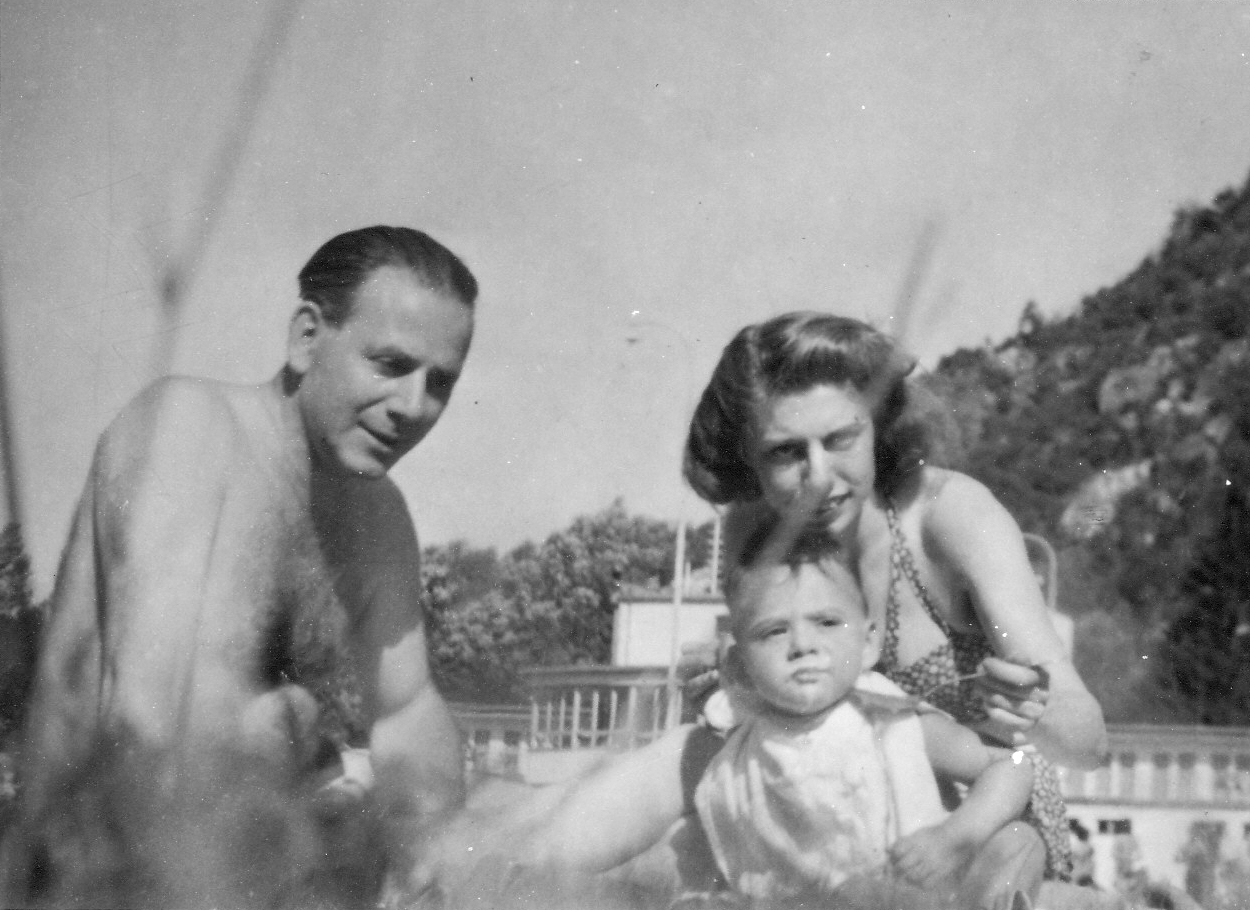
Ferenc survived the Second World War as a forced labourer, married Vera Kincs in 1946, and in 1949 emigrated with her and their infant son to Israel, where he became head of the fire and baggage-handling crews at Ben Gurion Airport.
Beginning in 2010, my father reached out to the Klapka György Múzeum and gave it the family photographs and the images of his uncle’s paintings that the Israeli branch had kept; those gifts are recorded in Számadó Emese’s 2019 catalogue (/bibliography#szamado-2019, p. 6) and are part of what this archive draws on.
I mention this because it shapes what the archive can add. Alongside the scholarship assembled in Hungary, the family preserved its own side of the record: the photographs, documents, artwork and first-hand memory it carried through the Holocaust in Europe and the 1949 emigration.
The maternal line: Schaar and Kincs
My grandmother, Vera Kincs (born Komárom 1921, died Petah Tikva 2018), survived Auschwitz and later taught English in Israel. She left a written memoir of her childhood in Komárom and her mother’s family, the Schaar line of Galánta and Bratislava, and seven hours of video testimony to the Yad Vashem Institute in Jerusalem.
The family’s Holocaust losses, its connection to Henrietta Szold, the founder of Hadassah, and Vera’s memoir of the Schaar line are set out on the /holocaust-memorial page.
Images and rights
The photographs and family material presented here are stewarded by our family; the painter’s works are themselves in the public domain (he died in 1930). How images are credited, licensed, and how to request use is set out on /rights-reproductions. Corrections and additions are always welcome through /corrections.
Acknowledgements
This archive rests on the scholarship of Számadó Emese and the Komáromi Klapka György Múzeum, whose 2019 catalogue it draws on throughout and whose collection is the largest single holding of Rauscher’s work; see /klapka-muzeum. It also builds on the earlier work of Gálig Zoltán and Dr. Zsembery Dezső, and on the records of the institutions credited on /methodology and throughout the /bibliography.