Rediscoveries
György Rauscher’s oeuvre was nearly complete in the record by 1935 and then mostly disappeared from view for decades. Since then works and documents have re-emerged in distinct waves: a scholarly recovery beginning with Gálig Zoltán in the 1990s, the family photographs and pictures contributed to the Klapka György Múzeum from 2010, and, most strikingly, a group of paintings found in a Bratislava cellar and shown at Esztergom in 2015. This page tracks those returns.
The 2015 Bratislava-cellar finds
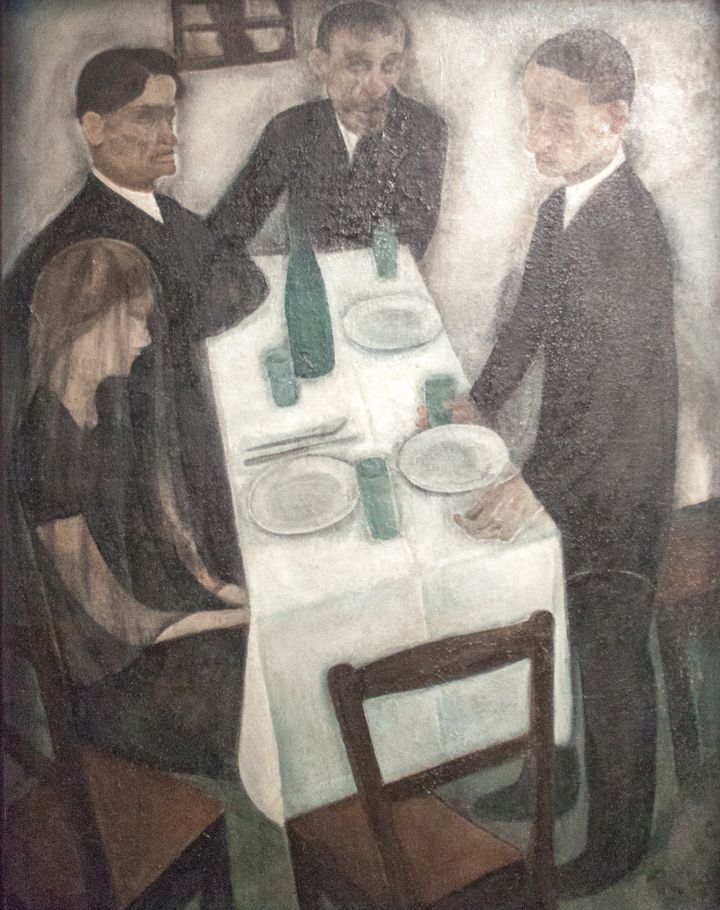
In 2015 a group of Rauscher paintings that had been stored in a cellar in Bratislava resurfaced and were shown at the Esztergomi Duna Múzeum. They include Halotti tor (Funeral Feast, 1927, also recorded as Asztal körül / Tor), catalogue no. 22 of the 1935 estate exhibition; Szerelmespár (Lovers, 1927), the composition recorded as Csók (The Kiss), catalogue no. 11; and Öltönyös férfi kaktusszal (Man in Suit with Cactus, c. 1928), a signed canvas (/bibliography#szamado-2019, p. 44). These were works known until then only from the 1935 catalogue, so their reappearance restored canvases to the located oeuvre for the first time in eighty years. The relevant work records are /works/halotti-tor-1927 and /works/szerelmespar-1927.
The catalogue reproduces the man-with-a-cactus canvas under the short title Férfi kaktusszal (p. 20); the archive treats Férfi kaktusszal and the saleroom title Öltönyös férfi kaktusszal as the same painting.
The family contributions from 2010
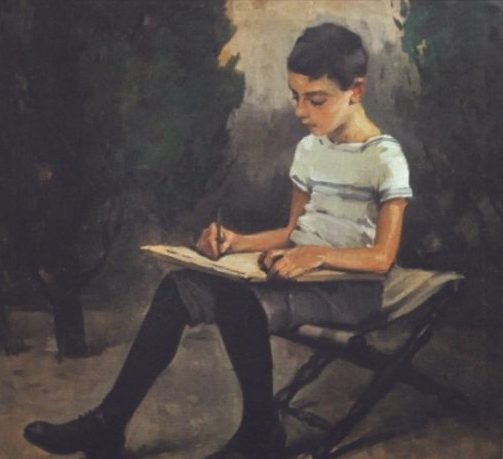
From 2010 onward the painter’s nephew contacted the Klapka György Múzeum from Israel and gave it family photographs and photographs of his uncle’s paintings that the Israeli branch of the family had kept; those contributions are recorded in Számadó Emese’s 2019 catalogue (/bibliography#szamado-2019, p. 6). Among the family-held material is an installation photograph of the 1935 estate exhibition itself, a direct copy of the series otherwise held in a Budapest research archive. This family stewardship, and the line it runs through, is described on /about.
Scholarly and institutional recovery
The art-historical recovery began with Dévényi Iván’s 1977 article, the first post-1945 notice, and gathered force with Gálig Zoltán’s Limes study of 1996 (/bibliography#galig-1996) and his expanded 2013 restatement (/bibliography#galig-2013), before culminating in Számadó Emese’s 2019 catalogue.
Since 2019 the additions have been institutional rather than scholarly: in March 2023 Rauscher was entered in the Komárom-Esztergom county heritage register (vármegyei értéktár), and the Klapka György Múzeum’s Rauscher collection is now displayed at the Brigetio Heritage Visitor Centre in Komárom. In June 2024 his work was shown in the Töredékek exhibition at the Komárom Menház, in a Holocaust-memorial framing alongside other Komárom Jewish artists; that exhibition is recorded at /exhibitions/2024-menhaz-komarom-holocaust and connects to the /holocaust-memorial.
The institutional home of the collection, and the scholarship that recovered it, are described at /klapka-muzeum.